EcoLedger
EcoLedger
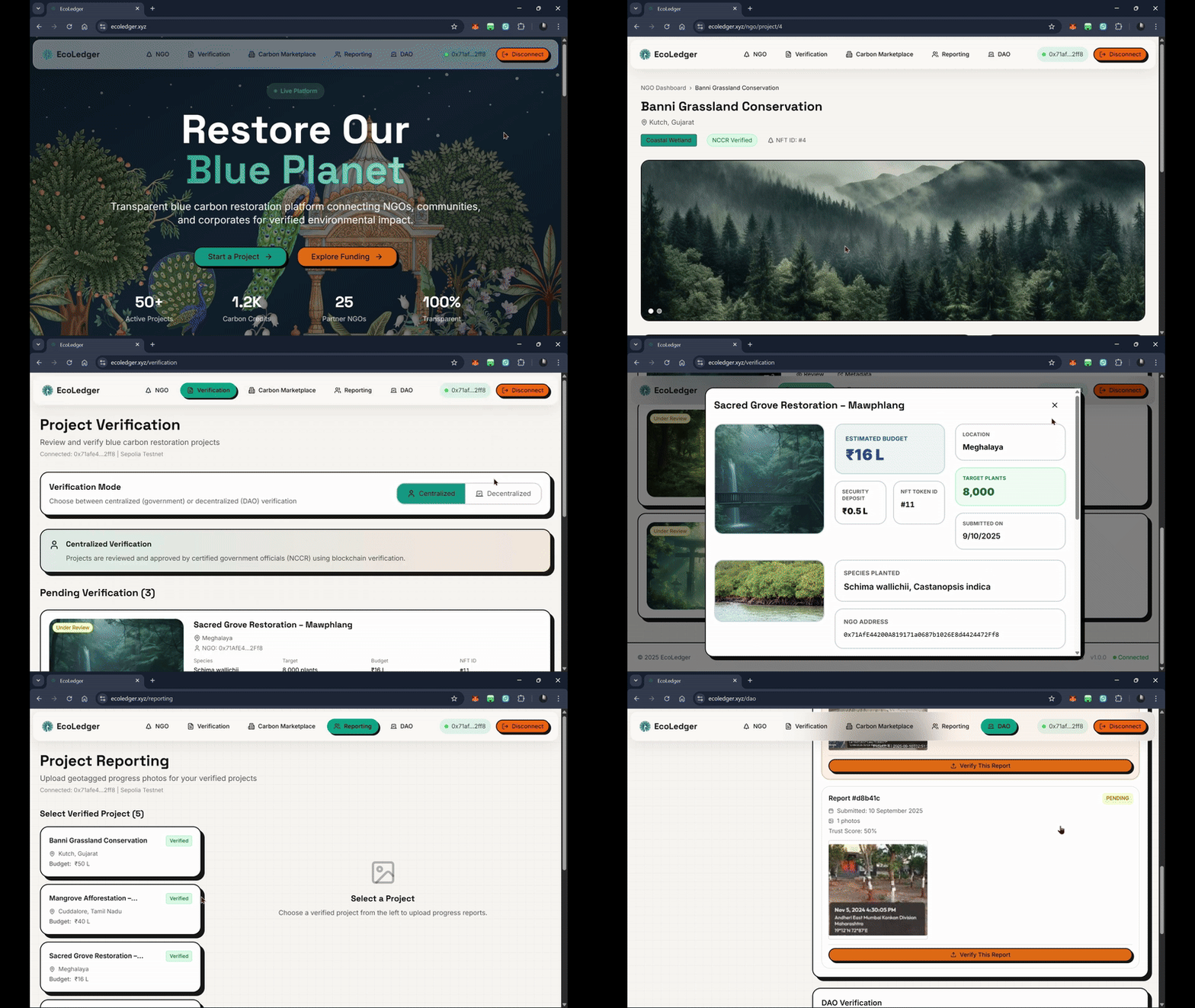
EcoLedger is India's first blockchain-based carbon marketplace, built for Smart India Hackathon 2025. We set out to solve a critical problem: India loses over six lakh hectares of forest cover annually, while corporations spend thousands of crores on CSR with no verifiable impact, and NGOs struggle to access transparent funding. Our intuition was simple. If we could put every project, every rupee, and every carbon credit on-chain, we could create a trustless system where transparency drives real environmental impact.
Even though we didn't make it to the finals, the depth and scale of what we built exceeded our SIH 2024 finals performance. This wasn't just a hackathon project. It's a production-ready platform solving one of India's largest environmental challenges.
The Story
The idea came from seeing three broken systems collide. NGOs have land and manpower but no funding pipeline. Corporations have CSR budgets but no verifiable impact. Government missions have ambitious goals but fragmented monitoring. We realized blockchain could solve all three by creating immutable audit trails, automated fund flows, and transparent verification.
For SIH 2025, we built a complete marketplace where environmental projects become verifiable NFTs, carbon credits are issued as ERC-20 tokens, and the entire MRV pipeline runs through AI and decentralized validation. Every stakeholder benefits from a transparent, incentive-aligned system. NGOs get direct funding. Corporations get verifiable impact. Government gets real-time monitoring. Citizens can participate as validators, earning while supporting environmental governance.
How It Works
When an NGO or community wants to list an environmental project, they create a complete digital record stored as an NFT on blockchain and IPFS. This NFT contains location data, species information, carbon capture estimates, biodiversity impact, and all documentation. Smart contracts automate the entire funding and reward flow, eliminating human intermediaries.
The verification happens through a dual layer system. First, NCCR officers validate project details, giving official backing for corporate CSR and carbon credit issuance. Then, a staked jury of community validators reviews the project data. Accurate validators earn rewards. Fraudulent submissions lose their security deposit. This ensures transparency and eliminates legacy middlemen.
Corporations can browse verified projects and directly fund them. In return, they receive ERC-20 carbon credits and NFT certificates. The entire transaction history is visible on-chain, and NGOs receive 95 percent of project funds compared to the 60 percent average in traditional models.
The monitoring never stops. EcoLedger integrates continuous MRV using a hybrid of AI and decentralized validators. EXIF analysis detects manipulated media. Geo-tag verification confirms ground updates. Validators continue to earn for ensuring authentic progress. Every update becomes part of the project's immutable timeline.
Technical Architecture
We built the frontend using React, Tailwind, React Router, React Hook Form with Zod, and React Flow for interactive project timelines. The UI is optimized for clarity and accessibility across devices.
Blockchain integration is powered by Ethers.js for wallet and contract interactions. IPFS with Pinata stores all project media. Sepolia serves as the testnet. MetaMask handles authentication and transactions.
Smart contracts are developed using Solidity, Hardhat, and OpenZeppelin. Contracts follow UUPS upgradeable architecture for safe long-term evolution. The system includes real-time on-chain transaction visuals, decentralized file storage, NFT metadata generation, multi-step project listing flows, community and government verification layers, interactive progress timelines, and an AI-assisted MRV system.
Why It Matters
For recruiters, this project demonstrates end-to-end blockchain development. We built smart contracts, implemented NFT standards, designed token economics, created DAO governance mechanisms, and deployed to production. We integrated multiple stakeholders, AI verification systems, and government workflows. The technical depth spans Solidity, React, IPFS, and real-world problem-solving at national scale.
The impact is tangible. NGOs get funding in days instead of months. Corporations get verifiable CSR impact with audit-ready trails. Government gets real-time monitoring across all projects. Citizens can participate as validators, earning while supporting environmental governance. The platform sustains itself through a small fee model designed for long-term scalability.
Traction
The platform runs live on ecoledger.xyz. Smart contracts are deployed to Sepolia. Multiple NGOs are onboarded for pilot testing. Discussions with NCCR teams are underway. Corporate interest is in progress for CSR integrations.
Deployed Contracts
Carbon Credit Token (ERC-20) is deployed at address 0xac88de244d4ea300c253539865e84d09a910682a. Project Certificate NFT (ERC-721) is deployed at address 0xb5a102735ea7efc3de53bb3d8b842ab23de32c49. These contracts power credit issuance and project representation on-chain.
The Vision
EcoLedger aims to become India's climate finance backbone. A future where every tree planted is verifiable, every rupee is traceable, every project is monitored in real time, and every stakeholder can profit while contributing to environmental healing.
This is climate action built as infrastructure, not charity. A transparent, incentive-aligned system designed for national scale.
Links
Website: https://www.ecoledger.xyz
GitHub: https://github.com/Percobain/EcoLedger